Carbon Dots (CDs)
직경이 10nm 이하인 나노미터 크기의 탄소 기반 입자
Graphene Quantum Dots (GQDs)
Carbon Nanodots (CNDs)
Carbonized Polymeric Dots (CPDs)
Characteristics
다른 나노 & 유기 소재와 구별되는 독특한 물리적 및 화학적 특성
Outstanding Photoluminescence
High Stability
Low Toxicity and High Biocompatibility
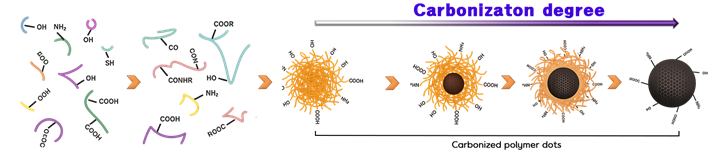
Synthesis
다양한 전구체 사용 가능한 유기화학적 합성
CNTs and graphene need high temperatures, catalysts, or costly equipment.
CDs are easily synthesized from various carbon sources

다른 나노 소재와 구별되는 생산 장점
대규모 생산 가능성
다양한 전구체 사용 가능
표면 기능성 조절 가능

에너지 저장 탄소 소재
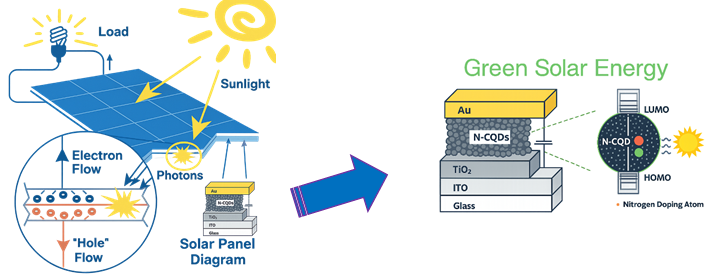
Solar Cells (Photovoltaics)
Photocatalysis
Artificial photosynthesis
Improving photovoltaic efficiency
The sun emits a lot of energy in the NIR region

배터리의 성능 향상 탄소 소재
Lithium-Ion Batteries (LIBs)
Sodium-Ion Batteries (SIBs)
Lithium-Sulfur Batteries (LSBs)
Integrated into anode to enhance performance
To modify the cathode, separators, and electrolytes

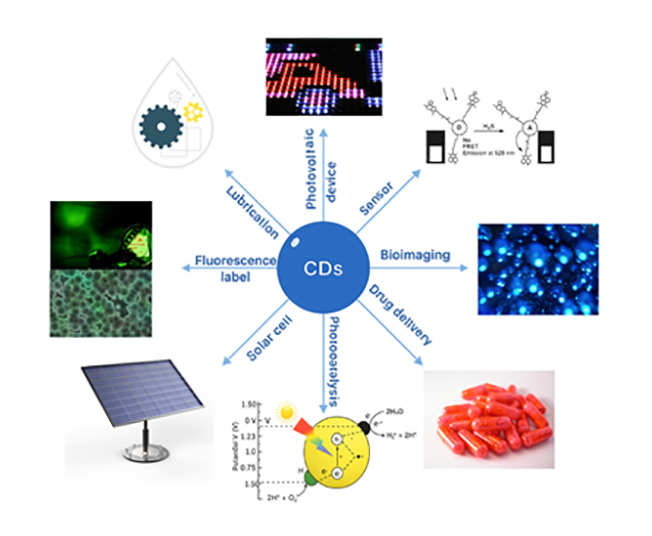
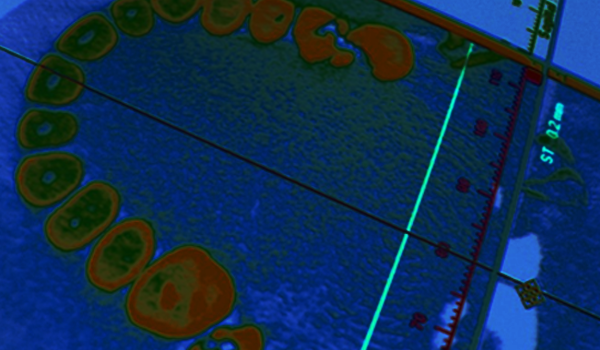
나노 크기의 차세대 이미징 탄소 소재
Deep tissue penetration
Excellent solubility & photostability
High biocompatibility
Near-Infrared (NIR) Emission for Deep Tissue imaging
Two-Photon imaging
Photoacoustic Imaging

The development of applications of carbon dots in advanced batteries.
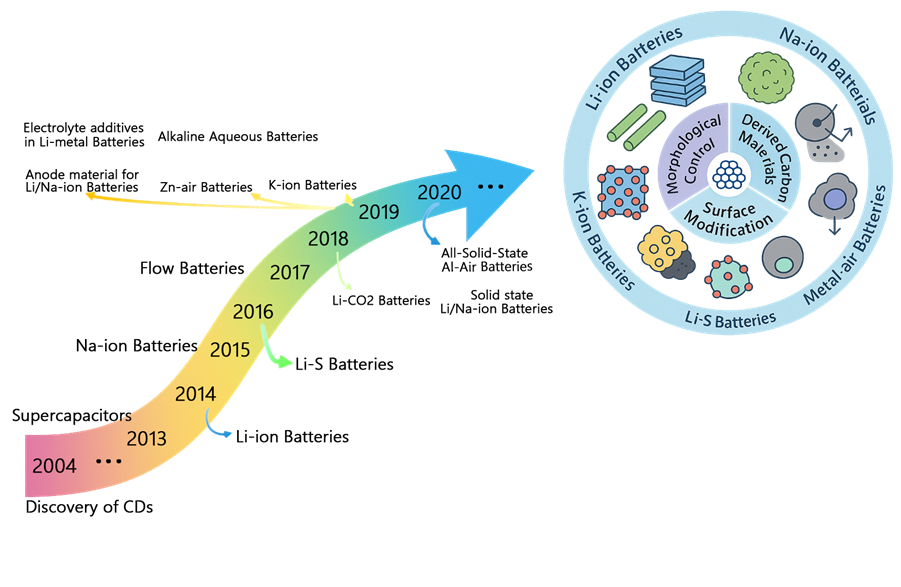
Battery에서 carbon dots의 역할
양극/음극에서 높은 전도성
전기화학적 안정성 향상에 의한 충/방전 성능 향상
분리막의 이온 전도성 향상
덴드라이트 형성 억제


태양 전지에서 CDs의 물리적 및 화학적 특성
Environmentally Friendly and Non-Toxic Material
Excellent Optical and Electrical Properties
Simple Synthesis and Low Cost
넓은 범위의 가시광선과 자외선 영역에서 높은 흡광 계수.
간단한 공정을 통해 대량 생산이 가능.
전도성 고분자, 금속 산화물 등 다양한 재료와 결합하여 태양 전지의 전하 수송층, 흡수층, 또는 활성층으로 사용.

다른 나노 & 유기 소재와 구별되는 독특한 물리적 및 화학적 특성
| Organic dyes | Quantum dots | carbon Dots | |
| Size(mm) | 0.5 - 1 | 6 - 60 | <10 |
| Stability | Poor stability to thermal | Poor stability to oxygen, water, and UV light |
Stable |
| Toxicity | Dependent on dyes | Potential toxicity | Non-toxic |
| Solubility | Dependent on dyes | Poor solubility | Good dispersion |
| Photobleaching | Poor | Stable | Deep Tissue Penetration, Low Autofluorescence |
두 광자의 에너지 합이 S0와 S1 상태 사이의 에너지 차이와 일치할 때
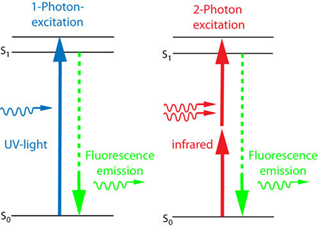
Two-photon excitation of carbon Dots.
우수한 광안정성 및 다양한 조절 가능 발광
Red and Near-Infrared (NIR) Emission for Deep Tissue
Two-Photon Imaging
Photoacoustic Imaging
Afterglow Imaging
In Vivo Imaging
Cellular Imaging